BAPI Video Library
Click on video to play or scroll down to browse all BAPI videos.
Blü-Test Instructions and Operations
The Blü-Test is a handheld temperature & humidity measurement probe that interfaces via wireless Bluetooth to the user's enabled Smart Phone or Tablet. After loading the free Blü-Test application, multiple points can be logged, time stamped with location and emailed for future reference or reporting.
Getting up and running is as simple as loading the Blü-Test App onto your phone or tablet and then syncing the Bluetooth communication between the Probe and your Device. To load the app, Go to "Google Play.com" and search for "Blu-Test". Click the Blü-Test Application icon and select Install.
All Videos
-
Blü-Test Instructions and Operations
The Blü-Test is a handheld temperature & humidity measurement probe that interfaces via wireless Bluetooth to the user's enabled Smart Phone or Tablet. After loading the free Blü-Test application, multiple points can be logged, time stamped with location and emailed for future reference or reporting. Getting up and running is as simple as loading the Blü-Test App onto your phone or tablet and then syncing the Bluetooth communication between the Probe and your Device. To load the app, Go to "Google Play.com" and search for "Blu-Test". Click the Blü-Test Application icon and select Install.
-
BAPI's VOC Sensor
Even though CO2 sensors are the most commonly used used for Demand Controlled Ventilation, they ONLY measure CO2 and ignore all the other contaminants which may be in the air such as the off-gassing of building materials, furniture, carpet, paint, cleaners or solvents to name just a few. These are some of the most harmful indoor air contaminants, and BAPI's VOC sensors detect them and thousands more, allowing you to ventilate them away before they can affect the health and productivity of the people in the building. A CO2 sensor simply can't do that. One of the best things about BAPI's VOC sensors is that they're as easy to use as a CO2 sensor. That's because the output has been converted to CO2 level, letting you use the Ashrae's CO2-based algorithm to ventilate. (Check out the videos and white papers on our website to see for yourself how the sensor provides APPROPRIATE ventilation whether the air contaminants come from humans or from other sources.) Besides being an alternative to CO2, BAPI's VOC sensors have proven to be effective in buildings and locations that have specific indoor air quality needs. For instance, the BAPI VOC sensors detect chloramines in indoor swimming pools, welding byproducts at fabrication facilities, formaldehyde and other chemicals in laboratories and even human sweat -- or body odor - in gyms and exercise centers. The list is nearly endless.
-
VOC Explanation by BAPI
Humans respirate Volatile Organic Compounds (VOCs) as well as CO2. The BAPI sensor measures these VOCs and indicates when a space is occupied just as well as a CO2 sensor. The advantage of the VOC sensor is that it measures air contaminants from other sources besides respiration, such as building materials, cleaners, perfumes and furniture and carpet off-gassing. Using this sensor for Demand Controlled Ventilation then is a way of achieving true indoor air quality, rather than just CO2 dilution.
-
BAPI's CO2 Sensor
When it comes to CO2 ventilation rates, what do the US Cities Madison Wisconsin; Denver Colorado & Miami Florida have in common? Considering the elevation differential is 5,273 feet, temperature extremes have been as much as -55°F to 114°F and RH extremes have been anywhere from 34.2 % in Denver to 83.9% in Miami... There's not a lot these locations have in common. So why have you been using "one-size-fits-all" CO2 sensors in your projects? Seasonal changes in temperature, pressure & humidity along with differences in altitude will cause other sensors to lose their accuracy, causing them to drift. This could cause over or under-ventilation resulting in increased costs and poor air quality. All of BAPI's CO2 sensors feature automatic background calibration which when installed, automatically compensate for these changes and help to keep costs down and air quality high. Field adjustable between F° and C°, BAPI's CO2 sensors are available as room and duct units. Oh, and if you've already been using our CO2 sensors, you'll be happy to know that we now offer a Calibration Kit. For more detailed information - or to place an order, go to bapihvac.com/CO2.
-
BAPI Blü-Test
Unlike other testing devices, the Blu-Test doesn't needs cords or wires and doesn't require you to purchase an expensive appliance or meter. It allows you to use a device that's already in your pocket! Once you've downloaded BAPI's free Blu-Test app to your Bluetooth enabled Android device, you are ready to start using the probe. The app has the capability of logging your test data with time stamps and locations. The app also gives you the ability to email your data logs right from your Android device, whenever and where ever you need to. Blu-Test has a fast measurement time of 10 seconds and comes with an NIST traceable certificate of calibration. For more detailed information or to place an order, go to www.bapihvac.com/blutest.
-
BAPI's Water Leak Detector
The Water Leak Detector is designed to sense the presence of water and alert a central monitoring system of the potentially destructive situation. Upon water detection, the alarm relay(s) change state, and a local red LED illuminates. The transmitter can be set for latching or non-latching alarm, and normally energized or normally de-energized operation.
-
Wireless Asset Monitoring (WAM)
The BAPI Web-based Wireless Asset Monitor (WAM) system allows users to monitor wireless sensors/transmitters from any of the popular web browsers. The WAM website is password protected and provides full administrative control. The WAM website works with any BAPI wireless sensor/transmitter to monitor parameters including temperature, humidity, doors and motion.
-
Differential Pressure Switch
BAPI's Differential Pressure Switch with field adjustable setpoint from .1" to 35" WC.
-
BAPI-Box Differential Pressure Transmitter
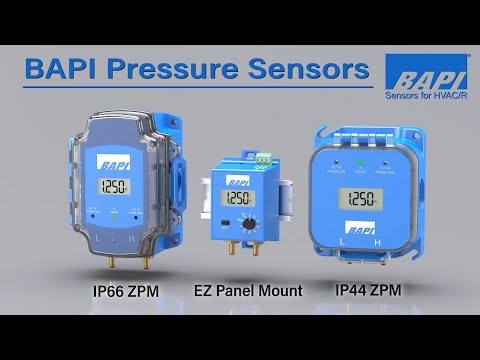
BAPI's Zone Pressure Transmitter is an accurate, rugged and economical solution for measuring and reporting duct/building static pressure, room-to-room differential pressure or air velocities/volumes.
-
EZ Pressure Sensor
Measuring building pressure and air velocities or volumes doesn't get any easier than with the BAPI EZ Pressure Sensor. The revolutionary mounting system allows for 2.75" snaptrack, DIN rail or surface mounting, and the three Outputs and 10 Pressure Ranges are field selectable by simply turning the rotary switch and pressing a button.
-
BAPI CO2 Sensor
An animation explaining why BAPI's new CO2 sensor uses temperature and altitude compensation to measure a building's CO2 level with more accuracy.
-
BAPI-Stat and BAPI-Stat 3
The BAPI-Stat and BAPI-Stat 3 temperature and humidity sensors feature large displays and are designed for easy wipe down cleaning.
-
VOC Overview
An overview of BAPI's Volatile Organic Compound Sensor.
-
VOC Explanation by BAPI
-
Story of BAPI
A quick overview of Building Automation Products, Inc (BAPI). How it got its start, the culture of the company and where it's headed.
-
Wireless Installations with BAPI Sensors for HVAC/R
A glimpse at some of the many wireless installations featuring BAPI sensors, including a 2,500-year-old mummy display and the body of a crash test dummy.
-
President of BAPI Hits Guard with Cricket Bat
BAPI President Ritch Stevenson uses a cricket bat to compare the durability of the BAPI-Guard thermostat protector to a competitor's thermostat protector.
-
Redesigned BAPI-Stat 3&4 Sensor Enclosures
Jonathan Hillebrand introduces you to the BAPI-Stat 3 and the BAPI-Stat 4 room sensors which are updated versions of the original BAPI-Stat and of the BAPI-Stat 2. Slimmed down, complementary colors and snappier buttons make the new sensors sleeker and more attractive while retaining the accuracy and versatility of the earlier models.
-
BAPI-Com
BAPI Product Manager Eric Karl describes how to simplify retrofit installations using the BAPI-Com 2-wire sensor. The BAPI-Com features Temperature, Humidity, Setpoint, Occupant Override and LCD — All on the 2 Existing Wires!
-
RµP Room Sensor-- BAPI HVAC
Product Manager Jonathan Hillebrand describes the features and benefits BAPI's line of microprocessor-based room temperature sensors, know as the RµP Family.
-
Dew Point Sensor from BAPI HVAC
The green revolution is increasing the use of chilled beams and chilled ceilings in commercial buildings. The temperature of the chilled water has to be regulated above the space's air dew point temperature or they will "sweat", promoting mold growth and dropping water on the occupants and their belongings. Mike Horan explains how BAPI's Dew Point Sensor is an easy and economical way to measure the dew point temperature so that you can prevent the sweating.
-
Clean Cut from BAPI HVAC
Clean Cut designer Wally Breuer shows how to easily remove knock-outs from the plastic BAPI-Box enclosures using the tool.
-
BAPI Button Sensor
Mike Horan shows how BAPI's "Button" temperature sensor is nearly invisible when painted the color of the wall. It's ideal for locations where aesthetics are as important as the temperature measurement.
-
Cornell University uses BAPI Wireless: 2009 Solar Decathlon
Watch how Cornell University used BAPI Wireless Sensors in their Silo House at the 2009 Solar Decathlon, hosted by the US Department of Energy.
-
Thermobuffer Temperature Sensor from BAPI HVAC
Mike Horan shows how to use the BAPI Thermobuffer to rid walk-in coolers or freezers of the false alarms caused by opening and closing the door during busy periods. The Thermobuffer measures the temperature of the contents of the cooler or freezer rather than the air temperature.